Going to Rave The Planet this weekend?
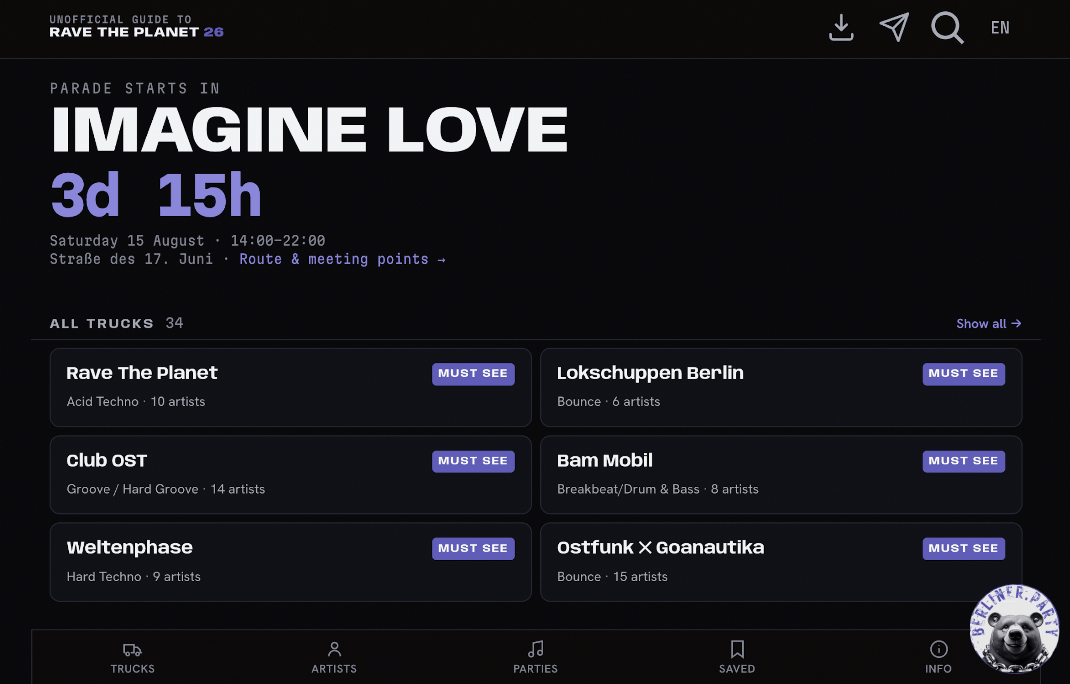
I built rtp.berliner.party because every year I found myself doing the same tedious archaeology: digging through Instagram posts, scrolling back through Telegram groups, opening eight browser tabs and cross-referencing three different websites, all just to work out basic things. Which truck plays what. When it rolls. Who's on it. Where to go afterwards.
That information exists. It's just scattered across every platform at once, in stories that expire, in posts that get buried. And it changes right up until the day.
So this year I stopped complaining and put it in one place.
What's actually in it
The guide covers the Rave the Planet parade on Saturday, 15 August 2026, and it's built around the four questions I always end up asking:
All 34 trucks — the complete list, with line-ups, music styles and published times. If you want hard techno, you can find the hard techno trucks without scrolling past everything else. If you want to know where the trance is, it's there.
All 382 artists — everyone billed on a truck or at a parade afterparty, searchable by name and style. This is the one I use most. You hear a name, you want to know when and where they play, you type it in.
All 18 afterparties — doors, line-ups, venues, tickets. From the big official one to the small club nights that will still be running when the U-Bahn starts again on Sunday morning.
Your plan — save trucks, artists and afterparties, and they land on one timeline so you can see your day in order and spot the clashes before they happen rather than while standing in the Tiergarten.
Practical and safety info — transport, safety, awareness, getting home. Sourced and dated, so you can see where a claim comes from and how old it is.
Plus search across the whole thing, because sometimes you just have half a name.
It works offline
This is the part I care about most, and it's the least glamorous.
A hundred thousand people in one place means the mobile network stops working. Not "gets slow" — stops. Every year, the exact moment you need to check where your friends are or which truck is playing next, your phone becomes a brick with a nice screen.
So the guide is built to install to your home screen and keep working with no signal. Load it once before you leave. It'll still be there in the middle of the Straße des 17. Juni when nothing else loads.
If that sounds like a small thing, you haven't tried to find a specific truck at 17:00 with 3% battery and no data.
What it is not
It's an independent guide. It's not affiliated with Rave The Planet GmbH, and I'm not speaking for them. Times and line-ups change — sometimes on the day — so if something matters to you, check with the organisers or the venue before you travel.
I'll keep updating it right up until the parade starts. If you notice anything missing or wrong, or you've got a suggestion, tell us. Genuinely. Every correction someone sends makes it better for the next person, and I'd much rather hear that something's broken than have it quietly stay broken.
Now the part I didn't expect to write
Rave The Planet is not a festival. It's a demonstration.
That isn't branding or a cute framing. It's a legal status, and it's the entire point.
The parade is registered as an assembly under Article 8 of the German Basic Law — the same constitutional protection that covers any political march. That's why it's free. That's why there's no ticket, no fence, no wristband. You can't sell tickets to a protest. Anyone can join, walk alongside, or stand at the edge and watch.
It's also why the whole thing exists in its current form. The Love Parade, which ran from 1989, spent years fighting over exactly this question — is dancing in the street a political statement or a commercial event? When the courts eventually decided it was the latter, the organisers became liable for the costs of a commercial event, and that was a significant part of what killed it.
So when Rave The Planet lists as its first political demand a "legal clarification of assembly laws to ensure that all non-verbal dance and music demonstrations, where dance and music serve as the sole means of political expression, are unequivocally recognised as assemblies under Article 8" — that is not an abstract legal wish. That's the ground the parade is standing on, and it's still contested.
What it's actually protesting
Here's the thing that made me stop and rewrite this section.
Five days before this year's parade, on 10 August 2026, the Clubcommission published Clubkultur Berlin 2026 — a 34-page study of the state of Berlin's club scene, seven years after their first one. It was presented aboard the Hoppetosse with the city's economics state secretary in attendance. The research institute Goldmedia ran the quantitative side; the Tresor Academy ran twelve in-depth interviews alongside it.
The study's own headline for what it found is "Volle Clubs, leere Kassen."Full clubs, empty tills.
That phrase is the whole crisis in three words, and it demolishes the laziest counter-argument — that clubs are closing because nobody wants to go out anymore.
People do want to go out. 83% of events fill more than half the room. Demand is there. And yet:
- Only 61% of clubs break even, down from 79% in 2017.
- 39% now close the financial year at a loss — nearly double the 21% of 2017.
- The hardest hit are mid-size venues, the 201-to-500-capacity rooms. Which is to say: not the world-famous institutions, but the places where a scene actually reproduces itself. Where a local DJ gets a first booking.
The causes have shifted in a way I found genuinely surprising. In 2019 the dominant threat was displacement — landlords, developers, rent. That hasn't gone away, and only 55% of clubs hold a lease of five years or more, which means nearly half the city's club infrastructure is operating on borrowed time by definition. But it's no longer number one.
Today, 85% name rising staff and operating costs as the primary pressure, and 60% name their audience's falling purchasing power. Berliners haven't stopped loving clubs. They have less money, they stay for less time, and over 70% of clubs report falling alcohol sales. The revenue model has quietly inverted: in 2017 roughly 60% of takings came from the bar; by 2025, 59% comes from the door.
Which pushes ticket prices up, which pushes people out. 92% of clubs agree that rising entry prices increasingly exclude lower-income groups. A scene born in abandoned buildings, free and open to anyone who found out about it, is pricing out the people it was for.
And the jobs are worse than most ravers realise. 36% of club workers are on Minijobs. Only 8% hold full-time positions with social insurance. Operators are being crushed by staff costs while the staff themselves are in some of the most precarious employment in the city. Nobody is winning that trade.
The roll call
Statistics land differently when you can name the rooms.
2025 was the worst year for Berlin clubs since 2009: 28 closures against 7 openings. A net loss of 21 venues in a single year.
Watergate closed after New Year's Eve 2024, after 22 years, citing the accumulated weight of Covid, rents, inflation and a shifting relationship between a new generation and club culture itself. The rooms sat empty for a year and a half. Only this month did the property group announce a new operator for the space.
Wilde Renate closed at the end of 2025 after eighteen years, when its lease with a well-known property investor ran out.
arkaoda announced it will close at the end of this month, after nearly nine years.
And the A100 motorway extension into Friedrichshain and Lichtenberg continues to threaten a whole cluster at once — ://about blank, Else, OST and others. Which is why "Stop the extension of Berlin's A100" sits on the parade's demand list, sandwiched between demands about noise regulations and world peace. It looks incongruous until you realise a motorway junction is one of the most effective club-closing devices ever invented.
Meanwhile rents in central districts have climbed roughly 38% in five years, and public cultural funding accounts for a grand total of 2% of club revenue — for those who can navigate the paperwork to get it at all.
Recognised, and still unprotected
Here's the contradiction the parade exists inside.
In March 2024, Berlin techno was added to Germany's nationwide inventory of Intangible Cultural Heritage, recognised by the German UNESCO Commission. It took a multi-year campaign, an initial rejection in 2022, and a rebuilt application backed by research, interviews and a documentary — a campaign led, as it happens, by Rave The Planet gGmbH itself.
So the culture is officially heritage. Formally acknowledged as something the country considers worth preserving.
It just doesn't come with any of the things heritage status implies. No protection from a lease expiry. No structural funding comparable to an opera house. No shield when a motorway is routed through the block.
The study estimates club culture's indirect economic contribution to Berlin at around €2.8 billion a year — more than the tourism value it generates, and a serious factor in why international workers move here at all. The city is running one of its most valuable cultural assets on Minijobs and five-year leases.
That gap — between "recognised as heritage" and "protected like heritage" — is what a hundred thousand people are walking about on Saturday.
The ten demands, in plain language
The parade publishes a list of demands each year. Most people never read them, so here they are, condensed:
- Legally clarify assembly law so that dance and music count as political expression under Article 8.
- Preserve and protect electronic music culture as recognised intangible cultural heritage.
- Treat electronic music equally with other art forms — fair funding criteria, committees with actual scene expertise, transparent distribution, modern tracking of club and DJ usage.
- Protect clubs and venues the way theatres, opera houses and museums are protected.
- Modernise noise protection and building regulations so cultural spaces and housing can coexist.
- Abolish statutory dance bans, including on "silent holidays" — a separation-of-church-and-state argument that surprises a lot of visitors who don't know it's still illegal to dance in public on certain days in parts of Germany.
- Establish an annual public holiday for electronic music culture on the second Saturday of July, the traditional Love Parade date.
- Peace and disarmament, from the interpersonal to the global.
- Protect human creativity and ensure fair revenue sharing for AI-based use of artistic work.
- Stop the A100 extension into Friedrichshain and Lichtenberg.
Some of those are concrete municipal politics. Some are broad enough to mean whatever you want. That's true of every demonstration's platform ever written. The core of it is unambiguous: treat this culture as culture, and stop letting it be dismantled by lease expiries and zoning decisions while everyone agrees in principle that it matters.
Why showing up counts
It's easy to be cynical about a protest you can dance at. The costumes are fun, the trucks are loud, and it doesn't feel like a political act.
But the mechanism is simple and it's the same as any other demonstration: a hundred thousand people on the street is a number that appears in the newspaper, in the council chamber, and in the calculation a politician makes about whether club culture is a constituency worth protecting. The legal status only holds if people keep exercising it. A demonstration nobody attends stops being evidence of anything.
You don't have to care about all ten demands. You don't have to carry a sign — though the organisers would like you to, and homemade signs are how the message actually becomes visible in photographs. Turning up in a ridiculous outfit and dancing for eight hours is, in this specific and unusual case, a legitimate form of political participation with constitutional backing.
That's a strange sentence. It's also just true.
Practical things for Saturday
The parade runs 14:00 to 22:00 on the Straße des 17. Juni, between the Brandenburg Gate and the Großer Stern, under the motto "IMAGINE LOVE". Because the western stretch is closed for construction until roughly 2029, everything happens on the eastern section — the floats line up along it and move back and forth, turning just before the Gate. There's no central stage; every truck is its own stage.
A few things learned the hard way:
- Load the guide before you go. Once you're in the crowd, the network is finished.
- Water and sunscreen. Eight hours, August, no shade to speak of.
- Earplugs. You are standing next to a wall of speakers for the length of a working day.
- Agree a meeting point with your friends, a physical one, and a time. Phones will fail you.
- It's a demonstration, so be one. Bring a sign. Take your rubbish with you — the organisers run a clean-up the next morning and it's a better look when there's less to clean.
- Plan the night before you're exhausted. All 18 afterparties, with doors and line-ups, are in the guide.
One more time
The guide is at rtp.berliner.party. It's free, it works offline, and I'll keep updating it until the parade starts.
Hope it helps. Have an amazing Rave The Planet.

About Berlin's own Nightlife Ambassador: With speaker ears tuned to the city's heartbeat and a chain symbolizing Berlin's rich techno heritage, Benny is more than just a mascot; he's a symbol of the city's pulsating nightlife. His encyclopedic knowledge of Berlin's clubs, DJs, and legendary parties makes him the ultimate guide for your night out in the city. From the most iconic clubs to hidden gems, Benny's insights ensure that you party like a true Berliner, every time. So, get ready to experience Berlin's nightlife through the eyes of its most vibrant and beloved bear!